The Wildflower Basket — Hand-Embroidered Moroccan Straw Tote
Taxes incluses. Livraison calculée au paiement.
Description
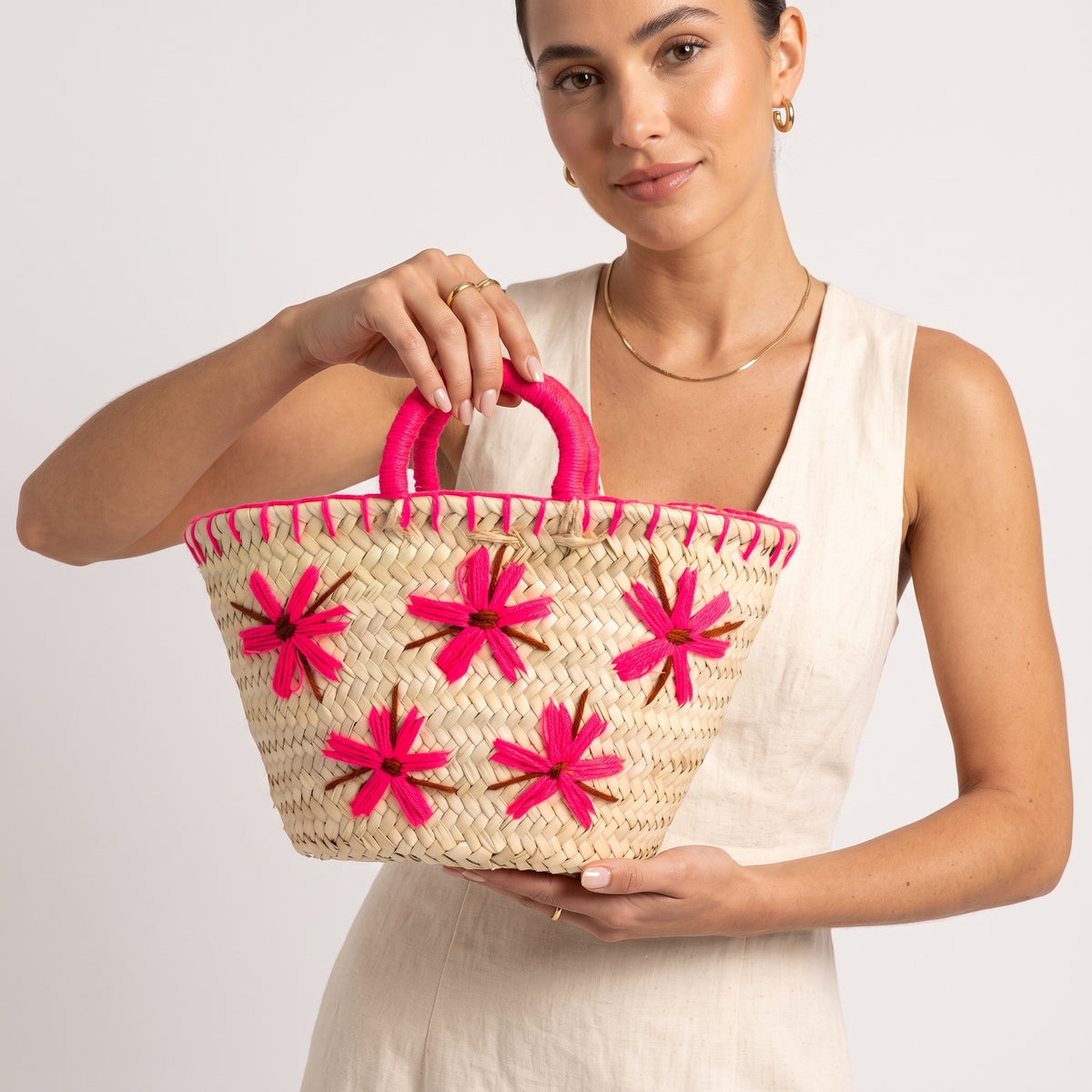
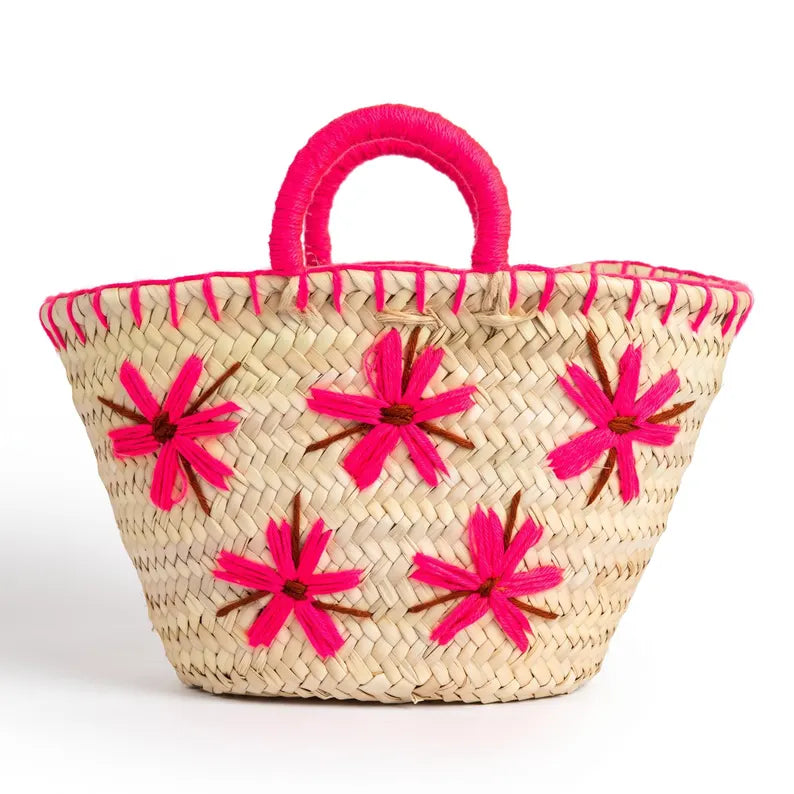
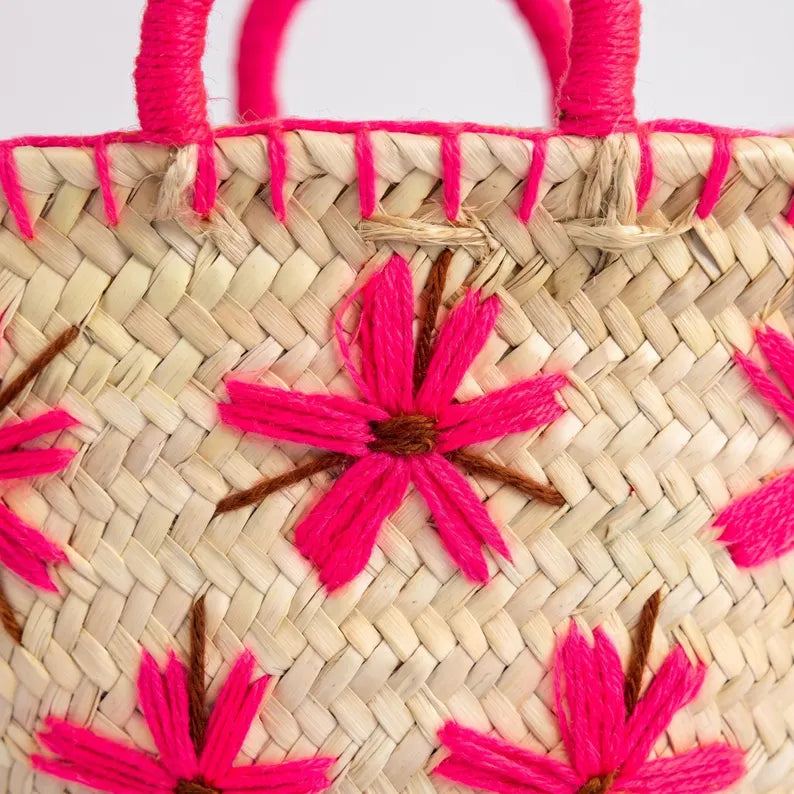
Five flowers, scattered across the weave the way they'd fall in a field rather than lined up in a row. Each one is six long petals of hot pink cotton stitched flat into the palm, with a brown centre and fine brown stems reaching out between them — so the flowers look like they're growing across the basket rather than sitting on it.
That flatness is the difference. Our cactus and pineapple baskets have crocheted appliqués that stand proud of the surface; this embroidery is worked into the weave, following the ribbons of palm, so the pattern belongs to the basket instead of decorating it. It's the quieter technique and, on a scattered floral, the right one.
The pink is not subtle and isn't trying to be. It's a proper fluorescent — the kind of pink that looks best in full sun against pale straw, which is precisely where this basket is going to spend its life. The same pink wraps the handles along their whole length and runs as a whipstitch around the rim, so the colour frames the basket rather than floating in the middle of it.
Underneath it's a traditional Moroccan market basket: doum palm, the wild palm that grows across the country, cut and sun-dried until it pales to straw, split into ribbons and woven by hand in the tight herringbone that every household here has used for generations. The natural straw is left bare between the flowers, which is what makes the pink land.
The handles are short — a hand or crook-of-the-elbow basket, the way market baskets have always been carried, not a shoulder bag.
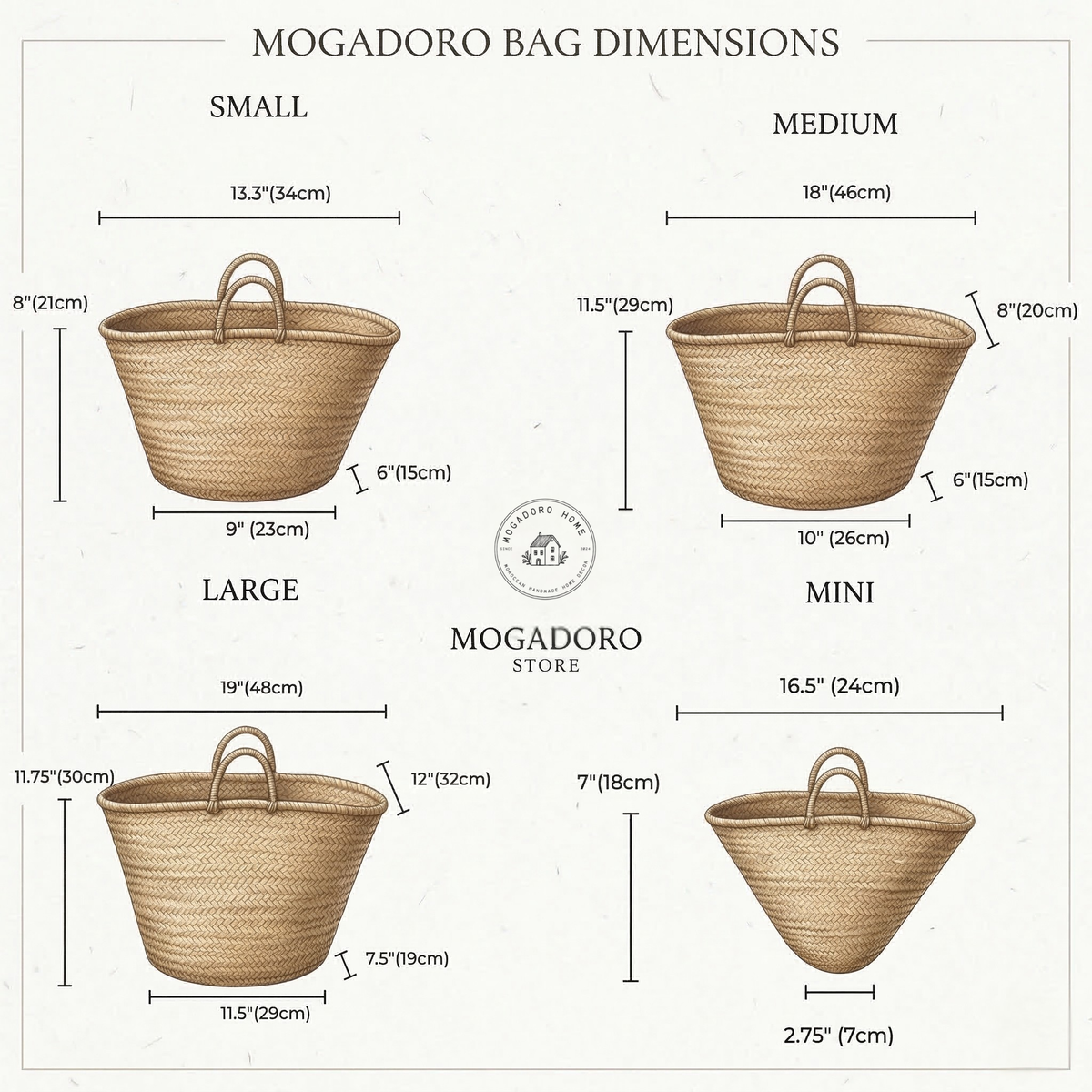
Three sizes, so choose by what you'll actually put in it: small for a summer purse or a child's first proper basket; medium for beach days and market mornings; large for towels for two and a bottle of something cold.
Open at the top and unlined — the traditional construction. It airs out after a damp swimsuit instead of staying wet.
Woven and embroidered entirely by hand in Marrakech, so the flowers fall differently on every basket. Yours will have its own arrangement.
Features & Specifications
- Material: Hand-woven doum palm straw (natural, undyed) with cotton embroidery and cotton-wrapped handles
- Detail: Five hand-embroidered flowers in fluorescent pink with brown centres and stems, worked flat into the weave
- Handles: Straw core wrapped in pink cotton thread; short hand-carry length. Matching pink whipstitch at the rim
- Sizes: Small, Medium and Large (exact dimensions per size — see note below)
- Closure: Open top, unlined — traditional construction
- Handmade: 100% handcrafted in Marrakech, Morocco. Ships directly from our workshop.
- One of a kind: Weave density, exact dimensions and flower placement vary between baskets. Small irregularities are the mark of hand-weaving, not defects.
- Care: Keep dry where you can; palm straw is naturally water-resistant but not waterproof. If it gets wet, air dry naturally away from direct heat. Dust with a dry brush. Store loosely stuffed to hold its shape rather than flattened. Spot clean the embroidery gently with a barely damp cloth — do not soak, as bright cotton dyes may run.
- A note on colour: Fluorescent dyes are the first to fade in strong sun. Beautiful in it, less durable under it — store the basket out of direct light between uses and the pink will stay vivid for years.
Livraison et retours
Expédié depuis Marrakech. Trois à cinq jours avec DHL ou FedEx. Trente jours pour changer d'avis.
Comment c'est fait
Coupé et cousu à la main dans notre atelier de Marrakech. Chaque peau étant différente, aucune pièce n'est identique.
